Weekly Market Pulse: June 15–19
Week in Review
It was a storybook week on Wall Street — one defined by a hawkish FOMC Wednesday that briefly rattled markets, a stunning Apple–Intel foundry deal that reshaped the semiconductor landscape, and a broad tech recovery by Thursday’s close. U.S. markets closed Friday for Juneteenth, but the four-day trading week packed enough drama to fill a month.
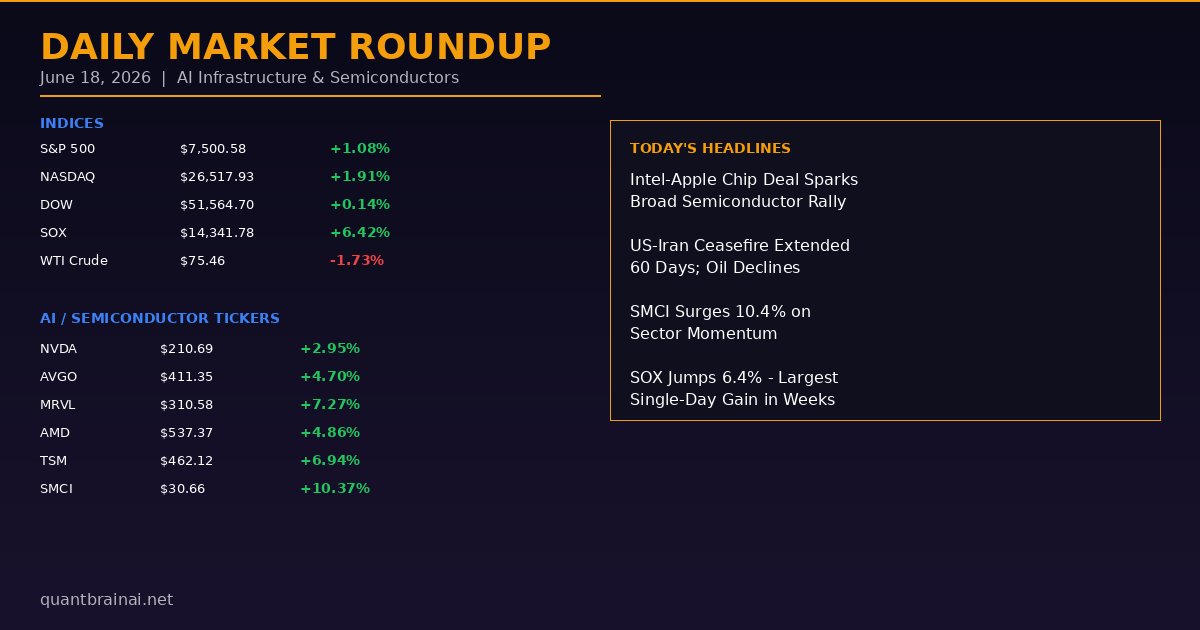
The FOMC held the federal funds rate at 3.50–3.75% on Wednesday — Kevin Warsh’s first meeting as Chair — with a hawkish tone that initially triggered a broad tech selloff. The S&P 500 dropped 1.21% to 7,420.10 on June 17, and the semiconductor sector lost additional ground. But the selling proved short-lived. By Thursday June 18, the S&P 500 surged 1.08% to 7,500.58 while the Nasdaq Composite jumped 1.91% to 26,517.93. For the abbreviated week, the Nasdaq gained 2.4%, while the Dow and S&P 500 each rose roughly 1% [WSJ, CNBC].
The semiconductor sector — which has now shed approximately $1.4 trillion in market value since June 1 — found a floor on Thursday led by Intel’s 11% surge on the Apple foundry deal and a broad equipment stock rally.
AI Semiconductors
NVIDIA (NVDA)
- Priced a landmark $25B bond offering on June 15 — its first corporate debt sale since 2021 — across seven tranches, upsized from the initial $20B target after attracting $85B in investor orders [Reuters]. Proceeds will fund AI infrastructure investment, including data center GPU production and CoWoS capacity prepayments
- Shares recovered 2.3% on Thursday as the broader tech rally lifted the entire sector, closing the week near $212
- The Vera CPU narrative continues to build: reports suggest Nvidia is pitching the architecture to Chinese hyperscaler clients as a credible x86 alternative for AI inference
Broadcom (AVGO)
- Concluded $2.5B in debt tender offers for six senior note series, with initial settlement on June 18 [Broadcom IR]. Stock gained 4.7% on Thursday
- The FY2027 $100B AI chip revenue target remains intact, with Google/Meta TPU/IPU demand providing multi-year visibility
- Shares are finding a bottom after the post-Q2 guidance selloff — the thesis shifts back to structural networking/ASIC demand
Marvell (MRVL)
- Outgoing CFO Willem Meintjes filed to sell $65M in stock (211,329 shares) [The Motley Fool]. New CFO Dan Durn (ex-Adobe) will take over
- Marvell recently joined the S&P 500 and remains positioned for the 800G/1.6T optical interconnect ramp — AI cluster scale-out is driving DSP and retimer demand
- Shares were relatively stable for the week, closing around $310
AMD (AMD)
- Fell 7.3% on Wednesday as the FOMC-driven semiconductor selloff hit hardest on names with weaker near-term guidance [MyFindEX]
- The MI400 launch in 2H 2026 remains the dominant catalyst. AMD claims 320B transistors and 432GB HBM4 on the next-gen GPU
- Open-source ROCm ecosystem is steadily gaining developer traction, but the Nvidia CUDA moat remains formidable
Qualcomm (QCOM)
- In advanced talks to acquire AI chip startup Tenstorrent for $8-10B — a transformative deal that would give QCOM instant data center AI inference credibility [Reuters]
- Stock rallied 6.17% on Thursday ahead of the June 24 Investor Day, where CEO Cristiano Amon is expected to detail the “Dragonfly” data center AI inference pivot
- The Tenstorrent acquisition would bring Jim Keller’s chip architecture expertise in-house — a direct shot at Nvidia’s data center dominance
ARM Holdings (ARM)
- Caught in the broad sector selloff with no ticker-specific catalyst this week
- The architecture licensing super-cycle narrative — mobile → PC → data center — remains intact. Mizuho’s $500 PT (from $250) still supports the elevated valuation
- Nvidia’s RTX Spark (Arm-based PC chip) and the Apple-Intel deal both validate Arm architecture’s expanding TAM
Memory & Storage
Micron (MU)
- Fell 6.2% on Wednesday in the sector-wide selloff, but options implied volatility implies an 11% move for the June 24 earnings report [Trefis]
- Consensus estimates: Q3 FY2026 EPS ~$19.96, driven by strong HBM3e pricing. Micron has sold out its entire 2026 HBM allocation
- The SK Hynix capacity tripling announcement (June 10) continues to frame the bullish memory supercycle backdrop. The key question for MU earnings: 2027 pricing visibility
Western Digital (WDC)
- Morgan Stanley raised its price target to $650 from $488 (an implied 30%+ upside), citing a global HDD shortage driven by AI data center storage demand [Invezz]
- Stock surged 14–17% on Monday in the strongest single-day move among the ticker pool. JPMorgan also lifted targets
- WDC has crossed 50% gross margins with 45% YoY revenue growth — the HDD business is undergoing a structural re-rating as AI training clusters require massive near-line storage
Foundry & Equipment
TSMC (TSM)
- Signed a 10-year advanced packaging partnership with Amkor Technologies at its Arizona campus [Amkor IR]. The deal completes a fully domestic US chip supply chain from fabrication through packaging and testing
- CoWoS capacity remains fully booked through 2027. TSMC is considering a 15% price hike for 3nm wafers in 2027 — its structural pricing power as the sole high-volume advanced node manufacturer continues to expand
Super Micro (SMCI)
- Finalized its $7B equity and equity-linked financing to fund AI server orders [Yahoo Finance]. The raise includes $5B in underwritten offerings plus $2B in at-the-market equity
- The company’s disclosed $39B in AI server orders continues to be the anchor narrative — but dilution concerns have pressured shares, now trading around $30.66
- Stock jumped 10.37% on Thursday — the cleanest green session since the June selloff began — as investors rotated back into AI infrastructure names [TIKR]
Intel (INTC)
- The week’s biggest story: Intel disclosed at the VLSI Symposium on June 16 that its next-generation 18A-P node has entered risk production, and by June 18 it was confirmed that Apple has agreed to work with Intel to design and manufacture chips in the United States [WSJ, TheStreet]
- Intel surged roughly 11% on Thursday, the best single-day performance among the ticker pool
- The Apple deal is a landmark foundry win — it validates Intel’s 18A process technology and positions the company as a credible TSMC alternative. Combined with Google’s “Icefish” chip talks reported earlier this month, Intel’s foundry narrative is gaining real customer momentum
ASML (ASML)
- The US Commerce Secretary raised concerns that China may have obtained an ASML EUV tool despite the 2019 export ban. ASML denied shipping any EUV machine or components to China [Reuters]. Shares slipped slightly on the uncertainty
- Longer-term, ASML’s raised 2026 guidance (€36-40B revenue) remains intact — high-NA EUV adoption for sub-2nm nodes is the structural demand driver
Applied Materials (AMAT), Lam Research (LRCX), KLA (KLAC)
- Citi raised price targets across all three names on NAND equipment demand strength [Seeking Alpha]: AMAT target to $710 (from $550), modeling 30%/22% revenue growth YoY in CY27/28
- All three equipment makers hit new all-time highs intraweek — a remarkable divergence from the broader semiconductor selloff, signaling that upstream WFE demand is secular, not cyclical
- The wafer fab equipment (WFE) spending forecast of $145B+ in CY2026 continues to provide a structural floor for these names
Cloud & Hyperscaler
Google / Alphabet (GOOG)
- Hyperscalers are on track for $5.3T+ in combined AI capex over the next several years [AOL]. Google separately is paying SpaceX ~$920M/month for compute capacity — a stunning figure that underscores the scale of the AI infrastructure build-out
- The $80B stock sale (announced June 1) funds this trajectory, with Berkshire Hathaway contributing $10B
Microsoft (MSFT)
- Microsoft has guided approximately $190B in calendar 2026 AI capex, including $25B from lease accounting [24/7 Wall St]
- The aggregate hyperscaler free cash flow picture is concerning: some analysts project it could go negative by Q3 2026 as AI capex grows 70% annually vs 23% cash flow growth
- Despite the capex overhang, Copilot adoption continues to mature as the enterprise AI revenue stream
Amazon (AMZN)
- Cited alongside MSFT and GOOG in the “capex sustainability” debate — AWS remains the revenue anchor, but the gap between AI infrastructure spending and cash flow generation is widening
- No major ticker-specific news this week, but AWS AI workload migration provides the incremental growth story
Oracle (ORCL)
- The company signed $67B in AI infrastructure contracts in Q4 FY2026 (reported June 10), including $75B in total prepaid/bring-your-own-hardware AI contracts [Oracle IR]
- The enormous RPO backlog ($638B) provides a multi-year revenue visibility that few other companies can match. The market’s concern remains dilution from the ~$40B FY2027 capital raise
Platform & Silicon
Meta (META)
- The Muse Spark AI model API delay continues to weigh on sentiment — the company has repeatedly pushed back the release as it works through safety evaluation pipelines [Reuters]
- Meta’s ad revenue engine remains robust, but the capital raise rumors that surfaced two weeks ago haven’t fully dissipated. The company is among the 4 hyperscalers in the $5.3T combined AI capex cohort
Apple (AAPL)
- Two massive developments this week: (1) The Apple–Intel chip manufacturing deal, confirming Apple’s move to diversify supply away from TSMC for some chip production; (2) Apple will allow third-party AI chatbots to integrate with Siri in iOS 27 [Apple World]
- The iOS 27 AI chat integration follows the WWDC 2026 Siri AI reveal — collectively, these represent Apple’s most aggressive AI platform push ever
- Shares were stable for the week as the market digested the Intel foundry news and the broader AI platform strategy
The Week Ahead
| Date | Event |
|---|---|
| June 22 | Existing home sales (May) |
| June 24 | Micron (MU) Q3 FY2026 earnings — the most important memory sector readout of the quarter |
| June 24 | Qualcomm (QCOM) Investor Day — Tenstorrent acquisition details? Dragonfly AI inference roadmap? |
| June 25 | GDP (Q1 2026 final revision) |
| June 26 | PCE inflation data (May) — the Fed’s preferred inflation gauge |
Key themes to watch: MU earnings on June 24 is the linchpin — HBM3e pricing, 2027 visibility, and memory cycle health will determine whether the memory supercycle thesis holds. QCOM’s Investor Day could be transformative if the Tenstorrent deal is formalized — it would signal Qualcomm’s ambition to become a credible data center AI player. On the macro front, May PCE data on Friday will either validate or challenge the FOMC’s hawkish posture. The Apple–Intel deal and TSMC-Amkor partnership both point to a structural re-ordering of the global semiconductor supply chain — watch for follow-on announcements at the end of the month.
Sources: Reuters, CNBC, WSJ, Seeking Alpha, The Motley Fool, Invezz, Yahoo Finance, SEC filings, company investor relations. This is not financial advice — do your own research.
← Back to all posts